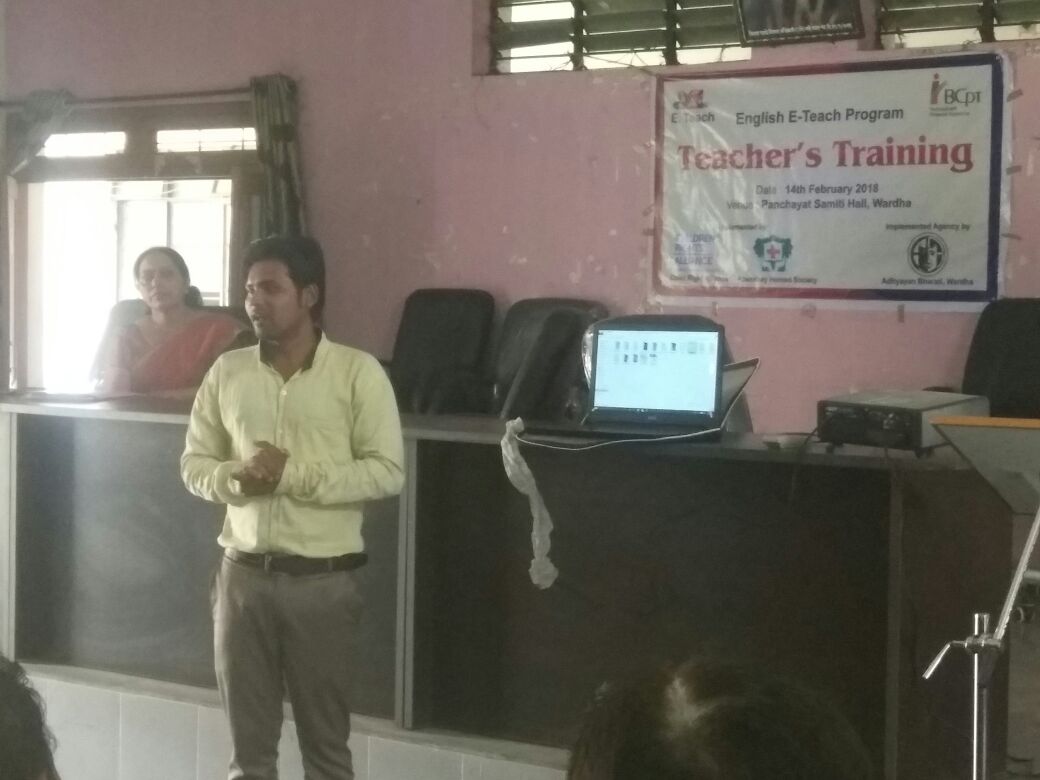
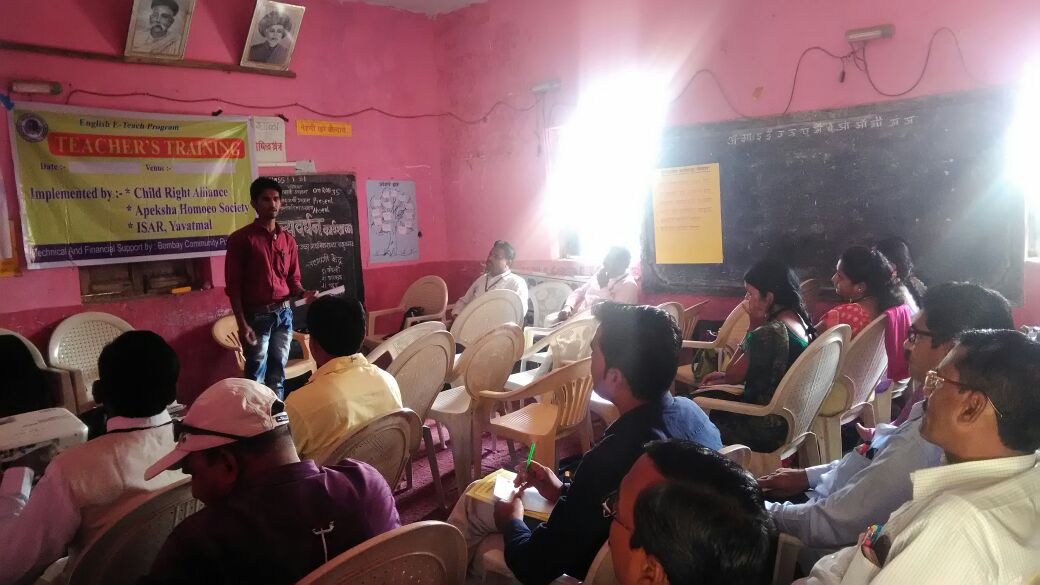
Teachers' Orientation Programme in Yavatmal
We thank the following organisation for their support to Project English E.Teach and their recent Teachers' Orientation Programme which was conducted on behalf of our BCPT team at Yavatmal in Maharashtra:
1. Child Rights Alliance
2.Apeksha Homeo Society
3. ISAR, Yavatmal
Date: 15th february, 2018
Venue: Babhulgaon


1. Child Rights Alliance
2.Apeksha Homeo Society
3. ISAR, Yavatmal
Date: 15th february, 2018
Venue: Babhulgaon


Teachers' Orientation Programme in Satara
A teachers' orientation programme was conducted in Dahiwadi Man Taluka (Satara) on 8th of February, 2018.
We saw a very good turn out of a good 208 teachers and a total of 215 English E.Teach DVDs were distributed to them.
The local SEO, Panchayat Samiti member and Deputy Collector also graced the occasion with their presence as the Chief Guest.


We saw a very good turn out of a good 208 teachers and a total of 215 English E.Teach DVDs were distributed to them.
The local SEO, Panchayat Samiti member and Deputy Collector also graced the occasion with their presence as the Chief Guest.


Teacher's Orientation Programme at Bhatane and Parol Kendra (Thane)
January 2018 has had a rather eventful and hopeful start to the new year for us! At a training session hosted by our English E.Teach's team members at Bhatane and Parol Kendra in Thane, Maharashtra, we saw an attendance of over 40 teachers and 120 parents.
A detailed teacher's orientation session was conducted, which was followed by multiple smaller, brief sessions for parents. We would have done a detailed session for the parents as well, but the numbers that turned out were so large, that we had to break up the group into batches and cut our sessions a little shorter to accommodate everyone.
All in all, it was a great day and we are proud of our team members who pulled off a great show.
End of the Year Updates of 2017
We often hear the quote, “How time flies!” And it is so
true. It feels like 2017 just flew by and just the other day, we posted the ‘End
of the Year Updates of 2016’ and here we are, discussing the year 2017 now.
2017 has been very eventful. As promised, we have reached deeper
into the remote areas of Maharashtra. And the local schools there are
enthusiastically using our DVDs now. A host of local newspapers have time and
again covered our work and our EET Mission. Our media coverage section has us beaming with pride. We even
featured in ‘Mumbai Mirror’, which is one of the most popular daily newspapers
in Mumbai.
When we set out with this project, our idea was to promote
the vernacular medium schools (because we firmly believe that core subjects are
understood better when taught in the mother tongue) and support them with an
aide that can ensure that the children learn English as a language, very well.
Today’s competitive time calls for a fluent knowledge English as a prerequisite
to any job. We can proudly say that in 2017, we have fairly succeeded in making
our message heard loud and clear. Institutions and most importantly, parents,
have understood this and there have been reports of an increase in the
admissions in the vernacular medium schools compared to the English medium
schools this year.
We are happy to say that we are proud of the positive
changes in the education system this year.
Seeing the overwhelmingly positive support from all corners,
we have initiated work on the STD five DVDs and they should hopefully be in
schools by the next academic year (June,2018).
On this positive note, we want to welcome the new year 2018
– with high hopes for a brighter future for our GenNext.
How to boost the overall morale of the class?
Teaching a class seems like the easiest thing to do, but it
is in fact the most complex of all processes. As a teacher, one is laden with
the responsibility of shaping the next generation. As a day to day interaction,
one may not be bogged down by the weight of this responsibility because one is
dealing with so much more in the class everyday, but it always haunts at the
back of the mind. To some, teaching may just be about getting done with the
syllabus or ensuring that the kids listen to them when they are talking. But
most often, teachers do much more than just this.
Teachers not only worry about teaching the class a
particular subject, but also think about the emotional and psychological
developments of the children. In spite of their busy schedules and lack of time,
they always know what’s happening with their children at a personal level. They
always know how each child is doing – whether a child is proactive or quiet,
enthusiastic or shy, having some troubles at home or has the potential to excel
in a particular field. Having a class of fifty odd children doesn’t handicap
them. Most teachers still manage to know the children in their class, personally.
But having said this, there are always instances when the
teachers get overwhelmed by a big class or a noisy class or a handful of very
active children making it difficult for her/him to concentrate on the other
students. What is she/he supposed to do
then? Are there any quick formulae to teaching that she can apply to ensure
that the shy children are not left behind? Or that the overall morale of the
class doesn’t go down because she is unable to (for various reasons)
communicate with the class the way she would have ideally liked?
The one thing that is of prime importance is that the
teacher’s aura should not be intimidating. Instead, it should be warm and
friendly towards the children. They should be able to approach her and confide
in her. And when in class, they should be able to participate, without the fear
of being yelled at for giving the wrong answer or for not knowing or
understanding something.
Here are things that when said often, help build the morale
of the class positively.
And the second thing is that a teacher must never just
concentrate on the kids that answer all the time or are very proactive. Once
you identify them, you know that they are listening. So now it is the time to
look for those who are quietly hiding at the back, and not participating. It is
important to push them to get involved so that they do not feel left out. Engaging
ALL the children is key!
There are many more articles like this that can help
teachers to make teaching a more joyous and effective experience. To read more,
visit our RESOURCES FOR TEACHERS section.
As we return back from our Diwali vacation…
Today’s generation is the most technologically advanced
generation. They have everything at their fingertips. It is also the most
ambitious and the most success-oriented generation. But we may not be able to
say that it is the happiest generation. There is so much pressure to perform –
everyone is competing either with others or with their own selves. The
definition of success now is totally different from what it used to be. Now
people don’t talk about or aspire to have a
stable career and life, or a ‘Government job. Now, people aspire to own brands.
The benchmark of success now is probably an IPhone or an Audi car.
Since even adults think like this, do you think the younger
children are far behind? No! They are also running the same race already. Every one is under pressure to perform in
exams. If school exams were not enough, there are a lot other competitive exams
now as well. And once they are older, there are entrance exams for specific
streams of higher education. Children these days study to excel in exams and
not to understand concepts. And there is so much pressure on them, that
vacations become the time that they really need to de-stress and re-energize
themselves.
We, at English E.Teach, strongly believe that there is a
certain flaw in this whole system and the way it functions. When we say system,
we do not mean the syllabus. Speaking for English, because that is what we are
mainly working on – the syllabus is pretty good and well thought out.
However, the way the
classes are conducted, needs support. The
education system as a whole, needs to provide a strong support system for the
teachers to function more efficiently. They need proper teaching tools and
resources – things or theories – that make teaching a more joyful experience
for them. And this support will ensure that the teachers do not succumb to the
various pressures that hover over them.
As we return back to school, post the Diwali vacation, we
ask all our teachers to pledge that they will work towards creating a better
environment for the students in their respective classes. And we pledge to help
the teachers in any way possible to do so.
P.S. For any teacher reading this, we have a whole section –
‘Resources for Teachers’, where we compile useful information that may come in
handy for teachers.
The IMPACT ASSESSMENT of the ENGLISH E.TEACH PROJECT
BCPT's English E.
Teach
is an effective intervention that brings quality English language to vernacular
schools from Std. I upwards, using the simple teacher-friendly technology of
audio-visual DVDs in the class environment. These DVDs are given absolutely
free of cost to schools and are custom-made to teach the prescribed Maharashtra
Government syllabus, page by page. It uses the existing school infrastructure
and existing teachers that the children are already familiar with.
These audio-visual English lessons make learning interesting and
enjoyable for children using short songs, interactive sequences and role-play, to
be facilitated by the teacher. English E.Teach helps children overcome their
fear of learning a foreign language and instills a confidence and proficiency
in English, that stays with them for life.
We undertook an in
house Impact Assessment with the main objective of looking at:
1) If there was in actuality an impact on building competency in use of the English
language in students of the vernacular schools using
English E teach
2)Where these students stand in comparison to students of vernacular
schools not using English E. teach, and English medium schools catering to the
same socio-economic strata as the children in said vernacular schools
3) Aspects and content of English E. Teach that need to be
highlighted when orienting teachers or offering them training. (This is being shared with those involved in these
processes and is not elaborated on in this write up)
HOW WAS THE IMPACT ASSESSMENT CONDUCTED:
1) School Based Assessment (BMC and Private)
This was conducted in schools that use English E.teach DVDs, testing
students in classes I to III. Criteria for eligibility was that the school
should have been using English E. teach for one full academic year at least,
i.e. from academic year 2016-17.
Schools that had the program in use in Stds I-III were preferred.
The 5 facilitators (who
liaise with schools and teachers, introducing the programme to them, training
teachers in its use and offering hands on assistance as and when required) selected
5 schools each, that met our requirements.
The assessment was conducted in a total of 30 schools.
An interactive session was designed for Stds. I - III. The time
available to us for actually conducting the sessions in class was limited, hence
only a few competencies could be tested.
A pair of facilitators conducted the session in each class, with
one facilitator noting the observations on a data collection sheet while the
other interacted with the students.
Data gathered this way is
labeled ‘School Based’.
2)Community Based Assessment
of Individual Children
This type of assessment was Conducted in communities by the
facilitators to compare performance of
vernacular school students of classes I
to III attending schools where English E
teach is in use, with the performance of
1) students of vernacular school
that do not use EET and
2) students of English medium schools that cater to the children
of a similar socio-economic strata as the vernacular schools mentioned above.
This was done in communities serviced by NGOs connected with
BCPT. The NGOs helped with the logistics of identifying the children &
bringing them together at a venue where the assessment could be conducted.
The proposed sample size for the community based assessment was
60 students of Std. I - III each. (We fell short by 5 in the actual collection
of data.)
In the communities, we followed a one on one pattern, with one
facilitator testing one child at a time, using formats designed for the
purpose. The core questions remained the same as those in the school based
assessment.
Data gathered thus is
labeled ‘Community Based’.
WHAT ARE THE
FINDINGS?
Subscribe to:
Posts (Atom)
-
One never runs out of quotes about the importance of smiling! Smiling is not only good for your own wellbeing, but also for those aro...
-
English E.Teach is a project where custom made DVDs are distributed FREE to the Vernacular Schools of Maharashtra, to help teachers conduc...